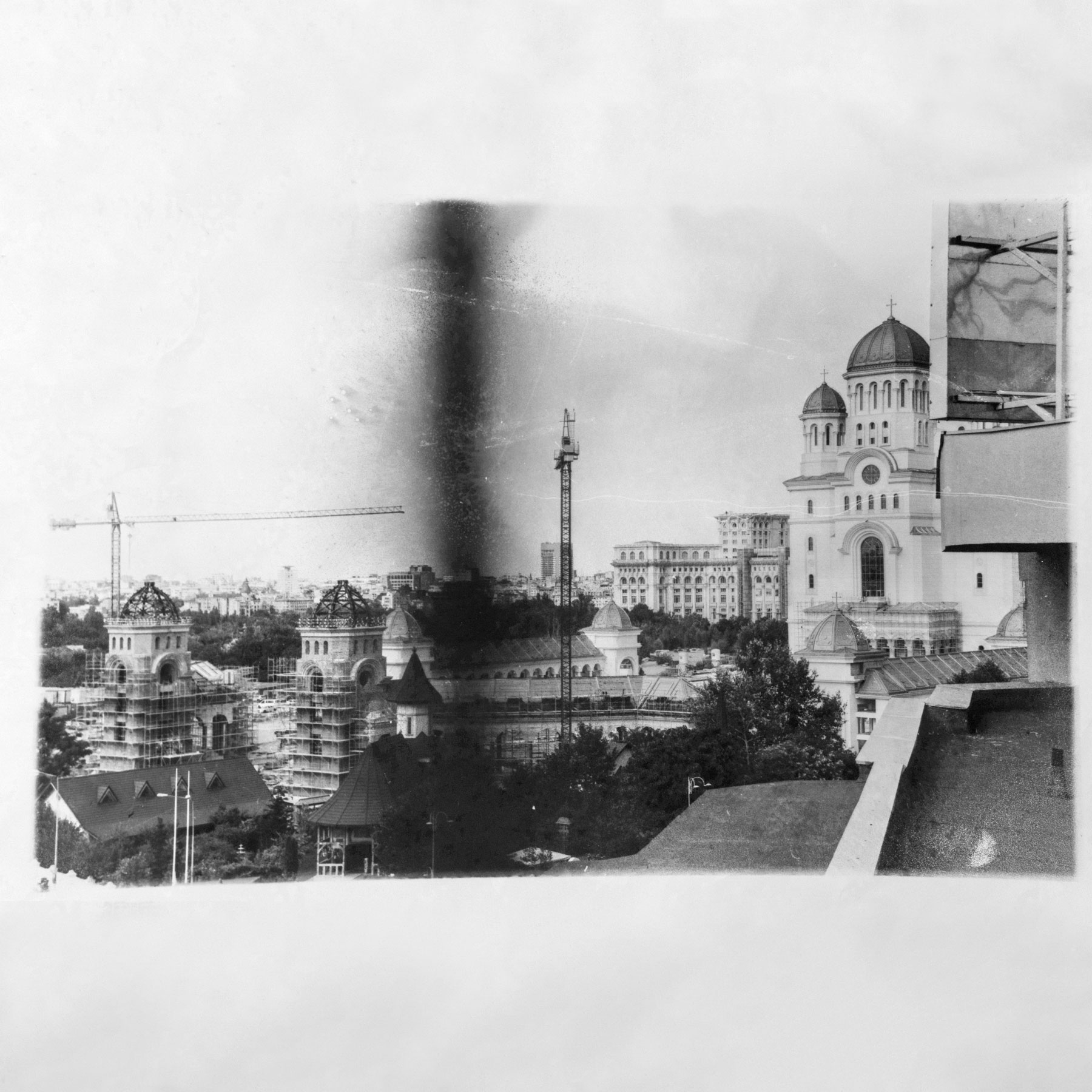
“Layers of Bucharest. Visual Radiographs of Urban Memory” temporary space NON art space in Bucharest ran from October 7, 2025, to November 13, 2025.
Bucharest is not a city, but a succession of overlapping cities. Each era has left its imprint on the consciousness of its inhabitants, archiving in shared personal memory communism with its transition, chaotic capitalism, and the digitalization of the present. Though seemingly different, all share a common trait: the assault of rules and conventions that shape lives and leave deep traces.
Using analog photography and plastic intervention, the project Layers of Bucharest explores these dimensions as visible scars, collectively tolerated through acceptance and forgetting. It is at once a radiograph of society and an invitation to reflection—to slow down and to listen to the city’s inner rhythm. Seen in this way, Bucharest becomes a living archive: an assemblage of memories and reminiscences, voids and mismatches, noises, silences, and unease.
The project investigates the tension between the monumentality of buildings and the forgotten everyday life within them. Massive walls become windows toward the interior and projection surfaces for memory, visual fragments, and urban sounds. The image is not documentary but evocative; it does not reproduce but interrogates; it does not assert but calls into question.
The central area of the research is Calea 13 Septembrie, a place charged with history and personal memory for the artist. From Dealul Spirii and the Revolution of 1848 to the construction of the House of the People, this site concentrates historical and aesthetic tensions. Today, between massive apartment blocks and luxury hotels, silences, shadows, and fragments of urban memory slip through—elements the artist reinterprets through the photographic lens.
Beyond the exterior city, the project also probes the domestic interior—the living room of childhood and adolescence, preserved intact by the artist’s mother. This space, a social nucleus and symbol of the family’s status, becomes in adulthood a badge of continuity, a layer of memory laden with meaning.


Sufrageria / Living room
The urban dimension is doubled by an investigation of the domestic interior, particularly the living room of the artist’s childhood, preserved as an artifact of familial continuity. This private space becomes an extension of the city—a micro-layer of collective memory in which the ideologies, aspirations, and aesthetics of an era are reflected through objects, furniture, and social rituals.